

Supporting Calm Naturally: Herbal Allies for Neurodivergent Teens
Aug 7, 2025
4 min read
0
8
0
When you’re raising a neurodivergent teen, the world often expects them to adapt to systems that weren’t designed for their unique way of thinking. That can lead to stress, overwhelm, meltdowns, shutdowns, and emotional exhaustion — not just for them, but for the whole family.
At Naturalis Herbal, we believe in the power of gentle, plant-based support. This guide was created to help you better understand neurodivergence, explore calming herbs that may help your teen, and empower you with clear, practical knowledge rooted in both tradition and science.

🧠 What Does It Mean to Be Neurodivergent?
The term neurodivergent refers to individuals whose brains function differently than what’s considered “neurotypical.” This includes:
Autism Spectrum Disorder (ASD)
ADHD
Sensory Processing Disorder (SPD)
OCD
Dyslexia and other learning differences
Tourette’s Syndrome
Anxiety and mood disorders
Neurodivergent teens may have incredible strengths — creativity, memory, empathy, focus — while also struggling with:
Emotional regulation
Sensory overload
Hyperactivity or inattentiveness
Difficulty with transitions
Sleep disruption
Meltdowns or shutdowns
The goal isn’t to “normalize” or medicate away these traits — it’s to help your teen feel safe, centered, and supported, with tools that match their needs.

🧠 What’s Happening in the Brain?
Let’s break it down:
🔷 ADHD (Attention Deficit Hyperactivity Disorder)
Brain Imbalances:
Low dopamine (especially in the prefrontal cortex)
Irregular brainwaves (low beta, high theta)
Poor executive function
Herbal Allies:
Cacao – boosts dopamine naturally
Rhodiola – supports focus and motivation
Lemon Balm – calms without sedation
🔷 Autism Spectrum Disorder (ASD)
Brain Imbalances:
Altered serotonin pathways
Sensory overload (from high input processing)
Emotional flooding from cortisol spikes
Herbal Allies:
Lavender & Chamomile – soothe sensory overwhelm
Ashwagandha – reduces long-term stress
Passionflower – calms looping thoughts and supports sleep
🔷 Anxiety, OCD, SPD
Brain Imbalances:
Low GABA (inhibitory/calming neurotransmitter)
High cortisol
Overactive beta brainwaves (racing thoughts)
Herbal Allies:
Lemon Balm & Passionflower – increase GABA activity
Ashwagandha – reduces cortisol
Valerian & California Poppy – support deeper rest

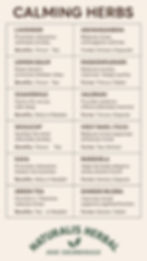
Primary Calming &
Supportive Herbs
🌸 Lavender
Reduces sensory overwhelm
Helps with panic and transitions
Supports deeper sleep
Best used: Bedtime or during meltdowns
🌿 Ashwagandha
Adaptogen for long-term stress and mood support
Balances cortisol levels
Enhances emotional resilience
Best used: Daily in the evening
🍫 Cacao (Raw, Unprocessed)
Boosts dopamine and serotonin naturally
Helps with focus, energy, and emotional regulation
Contains magnesium for nervous system support
Best used: Morning or midday
🌼 Chamomile
Eases nervous tension and digestive stress
Promotes calm without heavy sedation
Best used: After overstimulation or before bed
🍃 Lemon Balm
Lifts mood
Reduces anxiety and restlessness
Promotes calm focus
Best used: Before transitions or during school hours
🌺 Passionflower
Eases racing thoughts
Helps settle the mind before sleep
Best used: 30–60 minutes before bed
🌿 Valerian Root
Deeply calming for high anxiety or post-meltdown
May support sleep and reduce panic
Best used: Sparingly, at bedtime only
🌿 Expanded Herbal Toolkit (More Great Options)
🌿 Rhodiola Root
Boosts focus, motivation, and energy
Reduces emotional exhaustion
Best used: Morning or early afternoon
(Stimulating — avoid at night)
🌿 Holy Basil (Tulsi)
Balances mood and supports resilience
Helps with emotional reactivity
Best used: Daily, morning or early afternoon
🌿 Skullcap
Reduces nervous tension and irritability
Calms without causing drowsiness
Best used: As needed during high stress
🌿 Oatstraw / Milky Oats
Nourishes the nervous system over time
Great for emotional burnout or high sensitivity
Best used: Daily in tea or tincture
🌿 Blue Vervain
Helps with perfectionism and rigid thinking
Eases physical tension in the neck and shoulders
Best used: Evening or after emotional stress
🌿 Hops
Stronger sedative herb
Best for occasional deep sleep support
Best used: At night, short-term only
🌿 California Poppy
Gently calms anxiety without drowsiness
Helps emotionally sensitive teens wind down
Best used: Evenings or post-stress

High cortisol (stress)
→ Burnout, emotional flooding, sleep issues
→ Ashwagandha, Rhodiola, Tulsi
Low dopamine
→ Inattention, low motivation, brain fog
→ Cacao, Rhodiola, Lemon Balm
Low GABA
→ Anxiety, spiraling thoughts, panic
→ Passionflower, Lemon Balm, Valerian, Skullcap
Sensory overload
→ Meltdowns, shutdowns, irritability
→ Lavender, Chamomile, Blue Vervain
Irregular brainwaves
→ Overthinking, distractibility, mood swings
→ Passionflower, Lavender, California Poppy
⚠️ Important Safety & Usage Tips
✅ Always consult your child’s doctor before starting herbs, especially with medication.
✅ Use alcohol-free tinctures for younger children or allow tinctures to sit in warm water 5–10 minutes to reduce alcohol content.
✅ Introduce only one herb at a time and monitor for at least 3–5 days.
✅ Start with the smallest recommended dose, especially for sensitive teens.
✅ Herbs are tools — not a cure. Use them alongside therapy, structure, rest, and patience.
⚠️ Avoid valerian and hops during the daytime or before school — they may cause drowsiness.
⚠️ Not all herbs are right for every person. If your child reacts negatively, discontinue and consult a provider.

💬 Final Thoughts
Your teen isn’t broken — they’re wired uniquely. Supporting them doesn’t mean suppressing who they are — it means giving their nervous system the tools it needs to feel safe, steady, and strong.
Herbs can help. Not as a replacement,
but as a loving addition to your toolkit.
You’re doing an amazing job.
And we’re here when you need us.
💚 Naturalis Herbal


